


It is all too common, as Anne Applebaum wrote of Sen. Lindsey Graham of South Carolina, for a Republican politician to “abandon his previous ideals, to bury the patriotism that was once so important to him, and to become, instead, a loud, opportunistic collaborator.” We have seen a horde of figures in civil society make their Faustian bargain with Donald Trump and his authoritarian, white supremacist regime. However, for those in positions of responsibility in academe, Big Law, media, and business, there is an alternative to slavish careerism and unbridled ambition to climb the inner rungs of power.
Even when elite institutions appear ready to buckle, individuals and groups with modest financial resources and limited legal protections have proven that they can stand up — at great risk to themselves— and shame the accommodationists, thereby slowing the rush to collaborate with a tyrannical regime. The contrast between feeble ingratiators and principled dissenters has been especially vivid in the realm of higher education.
 |
Harvard, Penn, and a batch of elite universities have compromised academic independence and thrown diversity under the bus to ward off Trump regime threats to slash funding by signing off on agreements that compromise academic independence, allow government oversight, forfeit efforts to recruit a diverse student population, and cede protection for vulnerable LBGTQ+ students.
These sorts of agreements, which have been imposed at Penn and the University of Virginia, have been roundly condemned for abrogating First Amendment rights and academic freedom, two cornerstones of our democracy. “These agreements are vague, contradictory and contain unlawful terms that subject universities to ongoing legal jeopardy,” wrote two Yale alums currently teaching at Penn. “For example, following Virginia’s policy could imperil Yale’s laudable efforts to expand access to low-income and first-generation college students.” Some of these extortionist deals have limited foreign student enrollment and forced schools to discriminate against trans students. They’ve also opened a Pandora’s box of ongoing litigation. “Provisions that conflict with the law and with one another expose institutions to liability from all directions. Also, the use of vague terms such as DEI, gender ideology, and domestic terrorism bolsters executive discretion and invites overcompliance.”
Last month, we learned that the Trump regime was “conducting a far-reaching investigation into whether Yale University’s admissions practices violate anti-discrimination laws, prompting one of the country’s most elite schools to pursue settlement talks with the government,” the New York Timesreported. The Justice Department, as it has time and again, has speciously claimed that efforts to expand diversity amount to illegal discrimination. In this case, DOJ is not only attempting to bully the medical school (the focus of its original allegations of “illegal preferential treatment to Black and Hispanic applicants”), but also the law school and undergraduate programs. Not everyone at Yale, however, has been willing to roll over and play dead.
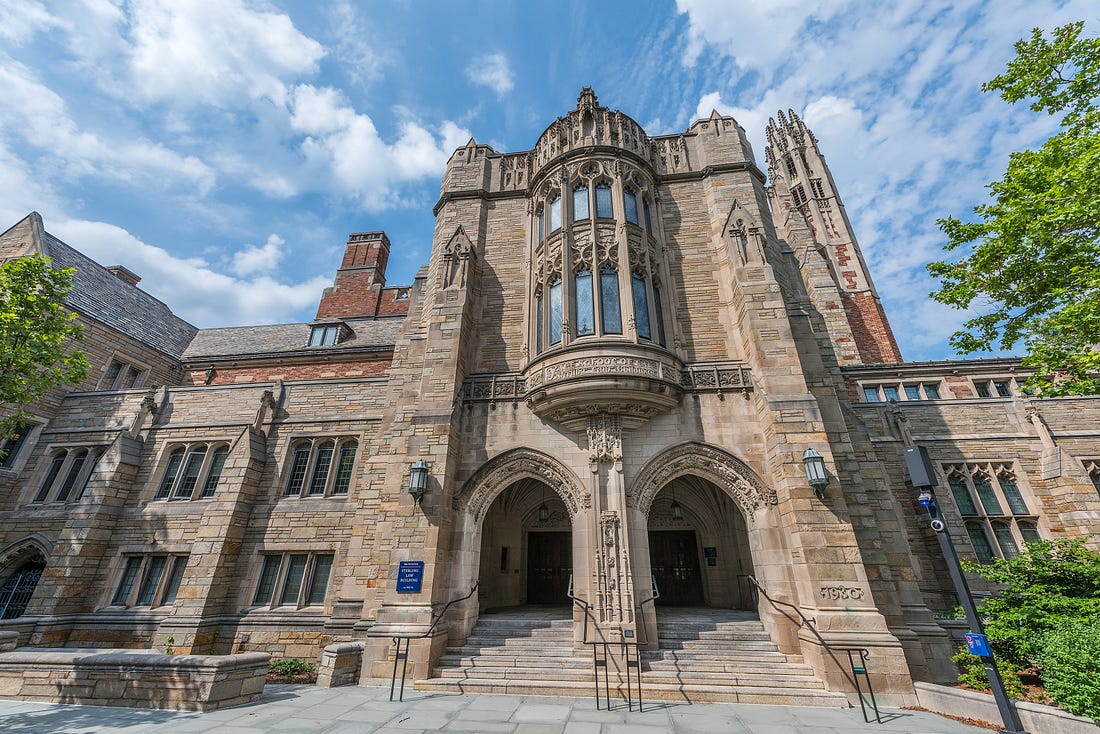 |
Fortunately, Yale’s law school dean and other faculty are leading the charge against the latest infringement on academic freedom and the crusade against diversity. “The dean, Cristina M. Rodríguez, and a group of law school faculty members have quietly lobbied top Yale leaders in recent days, arguing that the Trump administration cannot be trusted, and that settling would threaten the rule of law and the university’s reputation,” the New York Times reported. “They have even explored whether the law school could be excluded from any settlement with the federal government. Students, faculty, and alumni have been openly pressuring Yale President Maurie McInnis,” a sign that Rodríguez has a reservoir of support.
In an insightful interview with the Yale Daily News, Yale alum and former FTC commissioner Rebecca Slaughter (whom MAGA Supreme Court justices ruled that the president had unlimited power to fire without cause), reminded the Yale community that “it cannot be that I, Becca, normal human, had the wherewithal to challenge something that was wrong and an abuse of power, and Yale — with its $44 billion endowment — does not.” She acknowledged, “It’s not fun to push back — it’s much nicer to sort of think about how to walk away or make it go away in the short term — but it’s so much better in the long term to stand on principle,” adding that “especially as an academic institution, I think Yale has an incredible obligation to do that, and that obligation is to its students, to its alumni, to its faculty, to its employees, to its partners.”
 Subscribed
Courage may prove contagious at Yale, where an array of groups — including the Yale College Council, Yale College Democrats, the Yale chapter of the American Association of University Professors, and an alumni group “Stand Up for Yale” — have mobilized to put the kibosh on capitulation. Yale’s chapter of AAUP put out a letter declaring, “The choice before Yale is not simply whether to settle one investigation. It is whether to participate in a broader campaign to turn civil rights enforcement into a mechanism of political control.”
On Friday, Sen. Richard Blumenthal (D-CT) spoke at Yale alongside Yale students, alums, professors, and Mayor Justin Elicker to push back against collaboration. “We’re at a legacy-defining moment,” Blumenthal said. “Yale will be regarded either as a beacon and a fighter for academic freedom or as the weakling who succumbed and obeyed.”
Whether defenders of academic freedom can prevail at Yale or not, the concerted effort to object to spineless capitulation and force institutional elites to justify their actions is critical in the fight for democracy, preservation of First Amendment rights, and defense of civil society. When elites learn that capitulation will spark fierce criticism and exact lasting personal and institutional cost, they are much less likely to engage in Quisling behavior and more inclined, however reluctantly, to resist authoritarian intimidation.
As the Trump administration and its MAGA enablers now face frequent legal setbacks and edge closer to a potentially devastating midterm election, it is especially critical for democracy advocates to hold the line, refuse to give away precious democratic ground, and deny the Trump crowd any easy wins. Now, more than ever, it is time for Yale, higher education, and civil society as a whole to keep their nerve and refuse to voluntarily concede critical freedoms to a faltering fascist regime growing more desperate by the day to cling to power.
3 comments:
Hurrah for the principled folk at Yale. It has been heart-breaking seeing some many once honored institutions knuckle under to this corrupt regime.
The speed with which academia caved into Trump was horrifying. Hopefully the resistance will snowball just as quickly.
...I'm convinced that Trump could have blackmailed Graham with the release of information about his personal life!
Post a Comment