

Historically, autocrats often have turned out to be remarkably fragile, while effective mass movements have demonstrated unexpected strength to topple them. Donald Trump’s recent serial disasters vs. the burgeoning Resistance movement suggest the same might hold true in the U.S.
 |
Trump is sinking in approval in every public poll, with the University of Massachusetts Amherst poll reporting a new low of 33 percent approval. He is suffering from a crack-up in his base and rapidly losing young voters, Hispanics, and the “manosphere.” (About the latter, Elaine Godfrey writes that “the disillusioned young men and independents who voted for Trump in 2024 … can’t be expected to get out and vote for the GOP.”)
Discrete blunders (e.g., tariffs/affordability, the Iran war, the Epstein pedophile scandal, mass deportations, gas prices) might explain millions of voters’ disillusionment. But looked at with historical perspective, this sort of decay, characteristic of late-stage autocracy, flows directly from its defining features: corruption, cronyism, isolation from reliable information, and unalloyed faith in propaganda.
Each played a part in the predictable quagmire in Iran and the corresponding nosedive in Trump’s poll numbers. His head-spinning corruption (e.g. reapingbillions for him and his family from Middle East regimes) and cronyism (e.g., installing fan-boy incompetents such as Defense Secretary Pete Hegseth, sending ignoramuses Jared Kushner and Steve Witkoff to negotiate) set him up for failure. Tip: A corrupt leader surrounded by cronies can be played.
Making matters worse, Trump might be the least informed person in America, in part because all he consumes is a steady junk food diet of dramatic video footage, slobbering right-wing media coverage, and political sycophants’ cringeworthy flattery. (Looking at you, Speaker Mike Johnson!) The self-created information vacuum leaves him without reliable data about the state of the war, the sides’ relative weapons capacity, the Iranians’ leverage and objectives, and the impossibility of certain maneuvers (e.g., sending in troops to ferry out enriched uranium).
In the realm of state propaganda, Trump’s communication, even for him, has been terribly frantic and contradictory. He has become so accustomed to his cult’s uncritical acceptance of his lies (e.g., the “Sir” stories, fake history, incoherent blather “sane washed” by legacy media) that he is no doubt rattled when his bluster, threats, and transparent dissembling have no impact on the Iranians. Tip: Intoxication by your own lies is a serious handicap — as is deluding yourself into believing that implacable foreign enemies buy your nonsense.
 Subscribed
Put differently, autocracies are inherently brittle and susceptible to pressure because they eliminate the very things necessary to survive, such as reality-based decision-making, advisers picked on merit, a healthy flow of information, and the ability to discern spin from reality. (This sounds eerily similar to Russia’s Ukraine debacle, driven in large part by the “inefficiency, corruption, and brutality” of Vladimir Putin’s regime.)
The term for the point when autocracy goes haywire — autocratic backfire — “occurs when narcissistic leaders have insulated themselves from criticism by surrounding themselves with sycophants and loyalists,” Ruth Ben Ghiatexplains. At that point, “[n]o one will tell them the truth, and religious collaborators tell them they are in office by divine will…so they also end up believing their own propaganda about their invincibility, genius instincts, and infallibility.” They therefore are likely to make “decisions on the basis of erroneous beliefs or personal ideological obsessions.” No wonder the result is often military or economic calamities and bone-headed “policies and projects championed by the ruler out of hubris and megalomania and implemented to disastrous effect.”
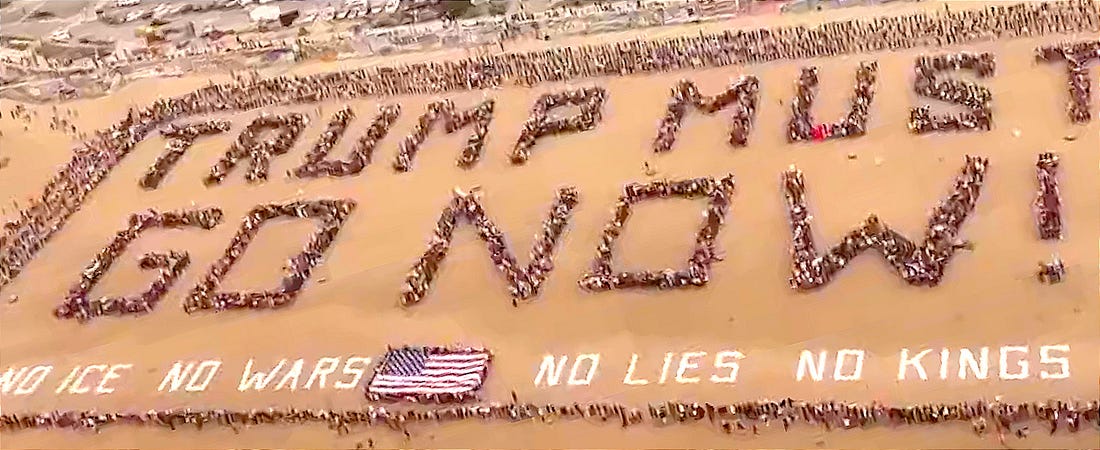
If Trump’s regime is brittle and subject to self-destruction, what about the Resistance? In polling, election results, and mass organizing events such as the No Kings protests, a vibrant grassroots movement has demonstrated surprising resilience, strength, and adaptability over 15 months.
Social movements scholar Dr. Liz Corrigan explains that mass events with huge turnout of people “who share some similarity of grievance against state actions” are critical to building a movement. Large numbers gathered without imposed ideological litmus tests encourage others to join. ‘Safety in numbers’ is real. “At protests, folks are registering voters, organizing volunteers, building databases for further actions, debating various courses of action, and creating relationships,” Corrigan observes. “It is literally how people build skills for solidarity actions as they are forced into more immediate confrontation with the state.”
Unlike autocrats, mass movements can adapt to new circumstances and embrace moments that can galvanize millions. The larger the number of activists, the more sources of information and ideas can be tapped to inform the movement. We saw the Resistance initially focus on direct opposition to DOGE with the “Hands off!” protest. Then it embraced the anti-corruption message that included the Epstein-Trump scandal (highlighting the Epstein elites’ avoidance of accountability). And most recently, ICE and the Iran War have supercharged the movement.
Mass movements — unlike inflexible, know-it-all autocrats — also can experiment with different models. Through trial and error, the movement can test new organizing methods (e.g., the Jimmy Kimmel boycott) and figure out ways to draw in different parts of the electorate.
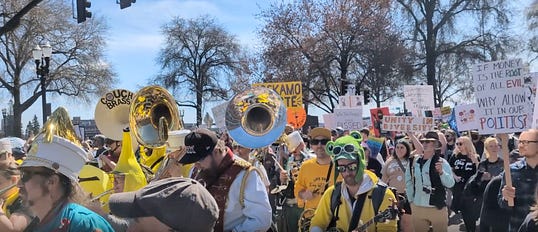
Perhaps most powerfully of all, while autocrats operate through violence, bullying, threats, censorship, and weaponization of the justice system, a successful mass movement is built on hope, solidarity, and, yes, love. It turns out mass movements suffused with joy, love, and mutual support have triumphed time and again over brutal and menacing regimes, whether in Turkey, Chile, or in the American Civil Rights Movement (anchored in its quest for a “Beloved community”). In the current context, we see the whimsical costumed characters, an ever-expanding array of witty signs, the near-total absence of any violence, widespread impromptu community-organized aid for immigrants, and consistent expressions of joy and a deep, abiding love of neighbors, country, and democracy.
 |
Certainly, victory over MAGA authoritarianism, brutality, and racism is far from inevitable. However, the Resistance can take solace that signs of Trump’s crackup are multiplying, the predictable result of erratic decisions from an isolated narcissist surrounded by yes-men. Trump’s version of autocratic backfire also reflects the growth of the Resistance movement, one large and flexible enough to sweep in millions of Americans, innovate over time, and propound a positive, uplifting message.
In sum, Trump’s profound weaknesses and the Resistance’s considerable strengths should give democracy defenders confidence to translate protest into organization and to redouble efforts to prevail in November, no matter what futile MAGA voter suppression tactics are deployed.
The Contrarian is reader-supported. To receive new posts, enable our work, help with litigation, and keep this opposition movement engaged, please join the fight by becoming a paid subscriber.
Thank you for being part of The Contrarian. Share this piece to help spread the word.