Just placed an order with Granddaughter #3 for Girl Scout cookies.
When I was a Girl Scout I went door to door. No such thing as soliciting online.

The cookies will arrive in less than 2 weeks.
Support your local Girl Scouts.
... is this written by Jennifer Rubin in the Contrarian
|
| |||||||||||||||
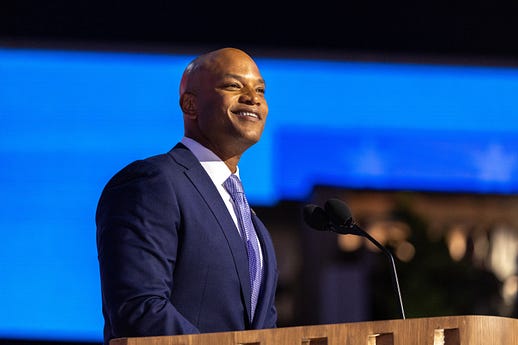
Maryland Governor Wes Moore (D) has been in office for just over two years, yet he has already made a big impression well beyond his state. That is due, in part, to his leadership in the aftermath of the Frances Scott Key Bridge collapse in March 2024. (By June, he was able to announce the Fort McHenry Channel had been cleared, far faster than many expected.) Moore, forty-six, is a Rhodes scholar, decorated combat veteran, financial entrepreneur, charitable foundation leader, and author of five best-selling books, embodies the “muscular progressivism” that I have written about (tough on public safety, focused on private sector growth, and determined to increase opportunity for all through smart investments in education, childcare, and health care.) His ebullient, sunny personality comes through, whether in a one-on-one conversation or a large gathering.
In an interview on Wednesday, Moore reflected back on the bridge collapse. “I will never forget that first morning—how cold it was and every camera in the world felt like it was there descending upon you. And you needed to give answers.” He rose to the occasion, laying down four markers: bringing closure to victims’ families; clearing the channel as fast as possible; protecting Marylanders from the economic fallout; and rebuilding the bridge. “Every bit of our work kind of went back to those four global goals,” he said. “And we're now on pace to accomplish all four” (with 100 percent of costs covered by the federal government). Soon, he will announce the “Progressive Design Build” and set a timeline to complete construction.
As somebody admired for his leadership, Moore describes two critical management principles: a “unified command” (i.e. appear with all partners at briefings, make certain everyone is on the same page) and “a regular communications cycle.” People get frustrated when the “only time they hear about things is when it's bad news.” A robust website, frequently updated, continues to provide reams of data on repair operations.
 |
Moore acknowledges that his approach stems directly from his military training. “I'm a combat veteran. This is how we were trained to kind of operate… [where] the only certainty is uncertainty.” He adds: “There has to be a measure of predictability for the people who you're working with, especially in times of crisis when nothing feels predictable. They need to be able to rely on you to give you a predictable cadence.”
Given his military background (and success in bringing down crime dramatically in the state), his reaction to the pardons of Jan. 6 felons is unsurprising. “The violence that we saw on January 6 has no place in our society…the peaceful transfer of power is a cornerstone of our democracy.” (He notes that downstairs in the building in which he now works, George Washington gave up his commission after the Revolution.) “It is the foundation of our democracy.”
Exasperated, Moore states he cannot understand the rationale for the pardons and commutations. “On that day we saw police officers who were attacked, people were violently assaulted, and the Capitol building was desecrated. Now, we're in this process of seemingly rewriting history.” He adds that with the temperature so high, what the country needs “more than anything else is a sense of healing.” However, he emphasizes, “This is not the healing that the country needed in this moment.” He vows to protect Maryland residents from any released felons who might return to the state. “It's unfortunate that we are not going to have accountability for what happened that day and what happened to our law enforcement officers,” he tells me.
Trump’s gusher of executive edicts has spawned several lawsuits (with more certain to follow). Maryland joined one to block Trump’s unconstitutional, unilateral repeal of birthright citizenship. Regarding the “deluge” of decrees, he points out: “Some are frankly performative, and some, as you've seen from our lawsuit, are just unconstitutional.” He isn’t surprised at Trump’s attack on immigrants, given the tenor of the campaign. “This is actually a promise being honored, but is very personal to me.” He explains, “I come from an immigrant family. I was raised by an immigrant single mother. When these derogatory statements are being made about immigrants and their contributions to our society, it's deeply troubling because you know they're talking about people like my mom… my grandmother and my grandfather.” Moore recalls, “When [my grandfather] passed away at eighty-seven, he had a deep Jamaican accent. And he was maybe the most patriotic American I've ever met in my life.” He adds, “I just want us to have policies that reflect our values and reflect our highest aspirations.”
Democratic governors around the country are in a difficult spot. On one hand, they feel an obligation to call out Trump’s cruel, counterproductive, and illegal policies; however, they also must get the necessary support from the federal government. Moore’s answer is straightforward: “I think about the oath that I took, and not just the oath that I took when I was wearing the uniform of this country but when I stood in front of six and a half million Marylanders.” He continues, “I took an oath to protect the Constitution. I took the oath to protect the constitution of the state of Maryland and the laws thereof, and I took an oath to make sure that I was protecting the people of my state.” He remarks that his oath was not conditioned on having a Democrat in the White House. All of that requires, as best as he is able, to keep doing the people’s business. On the day Trump began dumping executive decrees on the public, he recalls, “I was in Frederick, Maryland, announcing school construction. [Then] I went to go announce the rebuilding of Interstate 15.”
During his short time in office, Moore’s state went from 43rd in the country in employment to one of the lowest rates. He raised the minimum wage, made historic investments in childcare, oversaw a precipitous drop in homicides, and quadrupled apprenticeships. He wants to focus on delivering for working and middle-class people, a critical message for all Democratic governors.
Yet some policies, such as national energy policy, depend in large part on federal policy. He says the country got “spoiled” by a president who not only understood climate change but was determined to invest in green energy. “The IRA [Inflation Reduction Act] was a landmark piece of legislation,” he says. Leading a state that has seen huge investments in renewable energy, including off-shore wind generation., he remarks, “[A]n energy future that that should include solar and wind—I don't think that's a radical concept.” Likewise, he says there is nothing radical about giving car consumers options like electric and hybrid vehicles.
Moore is blunt that what most surprised him coming into office was how “messy” state government was. The economy had stalled, with budget growth outpacing economic growth. “We inherited a massive structural government,” he explains. “You saw this level of atrophy that came from all elements of state government, the vacancies that were here, the lack of accountability.” He was taken aback by “the brokenness that we saw within state government … and the lack of attention to detail that we walked.” He jokes, “As they say in real estate, we inherited this house ‘as is.’” (On his first day in office, he discovered a horrific scandal involving allegations of abuse at the Charlotte Hall Veterans Home.)
To address the budget crisis, Moore set out to “grow our economy and get more people engaged and involved in our economy.” At the same time, he had to show state residents that they “could have a government that could be modernized and efficient.” There is work to be done but in January he was able to announce a budget that “reduces the structural deficit by $2.25 billion for FY 2026, maintains a Rainy Day Fund balance of 8.0%, and flips the projected cash shortfall of $2.95 billion to a positive cash ending balance.”
Moore would be up for reelection in 2026. He has tried to damp down chatter about a presidential run. For now, his enthusiasm and military sense of organization will be essential as we navigate through the Trump years. If he does that successfully, few doubt he will one day be a contender for president.
Granddaughters #1 & #2 came over on Sunday afternoon. I put them to work drawing figures to use with FaceTime story time with granddaughter #4 who is turning three very soon.
They did a fine job.


I showed them both how adding a line grounds the figures instead of floating in air.
Here’s my Goldilocks.

Storytime will start on Wednesday. I did this for granddaughter #3 during Covid.
Now I need to make these cards stand up.
|
| |||||||||||||||
 |
Judges—especially in cases involving the Trump administration—should do more than just decide cases and resolve disputes. He or she should say more than “you win,” “you lose,” “allowed,” or “denied” without explanation. That might be efficient, much like a robot, but it is wrong.
The explanation, if the judge chooses to employ it, is key. It communicates a message to the public, enables that message to be understood by society, and contributes to the decision’s legitimacy and that of the Court. Professor Cass Sunstein referred to this as the “expressive function” of the law.
When federal prosecutors asked the judges in the District of Columbia to dismiss the cases against the January 6 defendants because President Trump had pardoned them, all they had to say was “allowed,” then rubber stamp the executive who had plenary power to pardon. Even though the courts had no discretion to deny dismissal in the face of the presidential pardons—as presidential clemency power is effectively unreviewable—an independent judiciary can still speak, if it chooses to.
To say nothing is to ratify the lie of President Trump’s pardon message. Trump, in his executive order late Monday, said he was ending “a grave national injustice that has been perpetrated upon the American people over the last four years,” in order to begin a “process of national reconciliation.”
But Judges Howell, Chutkan, Lamberth, Nichols, and Kollar-Kotelly refused to do so. U.S. District Judge Beryl Howell, appointed by President Obama, wrote in court filings that she would not dismiss the cases of Proud Boys Nicholas Ochs and Nicholas DeCarlo “with prejudice” — which would prevent charges to be filed against the men in the future. Agreeing to do, she said, would “let stand the revisionist myth” relayed in Trump’s proclamation that nearly all of the Jan. 6 defendants had been unfairly treated by the courts. She chose to explain that:
“The prosecutions in this case and others charging defendants for their criminal conduct at the U.S. Capitol on January 6, 2021, present no injustice, but instead reflect the diligent work of conscientious public servants, including prosecutors and law enforcement officials, and dedicated defense attorneys, to defend our democracy and rights and preserve our long tradition of peaceful transfers of power — which, until January 6, 2021, served as a model to the world — all while affording those charged every protection guaranteed by our Constitution and the criminal justice system.”
She added, with a pointed message of special poignancy: “No ‘process of national reconciliation’ can begin when poor losers, whose preferred candidate loses an election, are glorified for disrupting a constitutionally mandated proceeding in Congress and doing so with impunity.” There was, in fact, “[n]o ‘national injustice’ that occurred here, just as no outcome-determinative election fraud occurred in the 2020 presidential election.”
Judge Colleen Kollar-Kotelly, appointed by Ronald Reagan and former Presiding Judge of the United States Foreign Intelligence Surveillance Court, made it clear that she was writing “for posterity,” to record the truth of what really happened.
“Dismissal of charges, pardons after convictions, and commutations of sentences will not change the truth of what happened on January 6, 2021,” Kollar-Kotelly wrote, noting the events have been preserved through “thousands of contemporaneous videos, transcripts of trials, jury verdicts, and judicial opinions analyzing and recounting the evidence through a neutral lens.” These records, she noted, “are immutable and represent the truth, no matter how the events of January 6 are described by those charged or their allies.” In a particularly moving passage, she added, “Standing with bear spray streaming down their faces, those officers carried out their duty to protect.”
Likewise, Judge Tanya Chutkan, appointed by President Obama, in her order that formally ended the case against John Banuelos, who was charged with firing a pistol into the air on the grounds of the Capitol, made the harm affected by this defendant even more explicit: “The dismissal of this case cannot undo the ‘rampage that left multiple people dead, injured more than 140 people, and inflicted millions of dollars in damage.” Nor could dismissal “diminish the heroism of law enforcement officers who ‘struggled, facing serious injury and even death, to control the mob that overwhelmed them.’” Finally, the pardon, no matter what the president said, cannot “whitewash the blood, feces, and terror that the mob left in its wake. And it cannot repair the jagged breach in America’s sacred tradition of peacefully transitioning power.”
Even before Trump was inaugurated, Judge Royce C. Lamberth, appointed by President Reagan and also a former presiding judge of the FISA court, sounded the same themes. Any wide-ranging mercy for the January 6 rioters would be a mistake. He wrote that it was critical to “remind ourselves what really happened” on January 6: how an angry mob of Trump supporters invaded the Capitol, ignored directives to turn back, engaged in a “pitched battle” with the police, “stampeding through and over the officers.” Even Judge Carl J. Nichols, a former law clerk to Justice Clarence Thomas appointed by President Trump in his first term, made it clear that “blanket pardons for all January 6 defendants or anything close would be beyond frustrating and disappointing.”
It didn’t matter who the appointing president was, how long the judge had served, or how junior or senior they were. These judges would not silently rubber stamp this outrageous—even if lawful—decision of the new president. And they took pains to say so, loud and clear. An independent judiciary and impartial juries created a record that cannot be erased by the stroke of this president’s Sharpie pen. It is a lesson for us all.
Nancy Gertner is a former U.S. District Court Judge of the District of Massachusetts, now a senior lecturer at Harvard Law School, author, TV commentator and opinion writer.
Joel Cohen, a former prosecutor, practices white-collar criminal defense law at Petrillo Klein and Boxer in New York, and teaches at both Fordham and Cardozo Law Schools.